Monday, November 10, 2014

An Opportunity to Remember: The Loss of the Edmund Fitzgerald

Since I've been writing a novel that takes place in the shadow of Lake Superior in the years between 1975 and 1995, it seems only fitting that I commemorate the sinking of the Edmund Fitzgerald today, the 39th anniversary of the ship's loss. This is a solemn day for Michiganders, as we remember the many who have lost their lives on our lakes throughout the years.

If you're in the Detroit area, the Detroit Free Press has announced a commemoration for tonight:

The evening's activities are to begin with a lantern vigil at the Edmund Fitzgerald anchor, followed by a performance by Great Lakes balladeer Lee Murdock and an honor guard escort of a memorial wreath to the Detroit River for receipt by a flotilla of Great Lakes vessels.
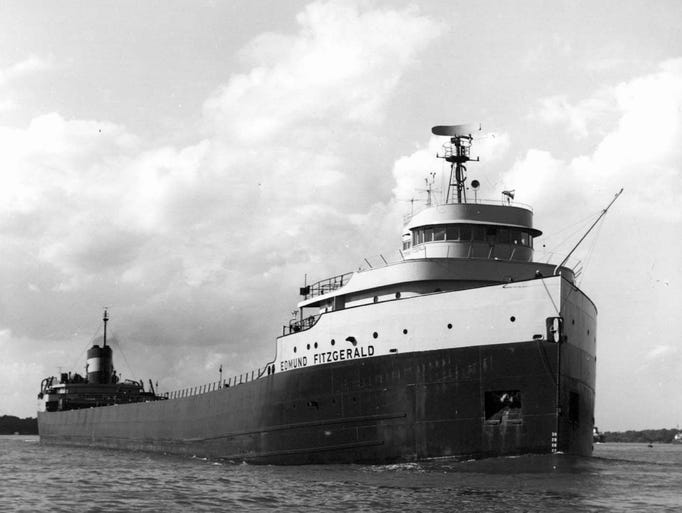

Edmund Fitzgerald
Photo from Detroit Free Press, November 10, 2014

My novel is not about the Fitz itself, but not coincidentally the action begins on the same night the great ship disappeared from radar. As a Michigan resident and someone who has seen many of these giant ships traverse the Great Lakes, it's hard for me not to be affected by the thought that such a large ship could sink below the water so easily. That idea haunts me--and surfaces in interesting ways in my writing.

Surprisingly, even though this was considered one of the worst maritime losses in Great Lakes history, few people remember much about the Edmund Fitzgerald these days. No such disasters have occurred on the Great Lakes in my lifetime, so many people find it hard to believe that the waters of the Great Lakes could have produced enough force to take the lives of somewhere between 25 and 30,000 people over recorded history. 

Tragedies like the loss of the S.S. Fitzgerald affect the collective memory of a region (thanks to Gordon Lightfoot's 1976 ballad, maybe even a country in the case of the Fitz) but are sadly often lost to time. After a generation or two, few remember the events of that night that seemed so terrible except for family members and history buffs. 

Perhaps that fading from our collective memories is the greatest loss of all. Perhaps that is why I write, bringing the events and people of the past into sharper focus for readers. Today, I will remember the men who died on November 10, 1975, in the icy waters of Lake Superior--and the many others who have also perished in service on the Great Lakes. 

What moments in your regional history do you consider important to commemorate? What will you keep alive through your writing?

Dream Writing Location?

I'm proud to be one of ten authors participating in a series called "Authors Answer" over at I Read Encyclopedias for Fun. Each week, we respond to questions about the writing process and writers. This week we're discussing our dream writing studio or office. Come by and join in the conversation! What would your dream writing location look like?


Sunday, October 19, 2014

Bartleby Snopes Contest Win Announcement

I'm thrilled and humbled to announce that the editors and judges of the Bartleby Snopes 6th Annual Dialogue Only Contest chose my short story "Everyone Smiles" as their second place winner. The story will be available online and in the semi-annual print magazine in January 2015. 

"Everyone Smiles" was a first for me--a short story entirely in dialogue without even speech tags.

The seed for the story was planted two years ago when I made a return visit to Lake Lure, North Carolina, infamous as a filming location for the 1987 film Dirty Dancing. I had originally been to the area when I was a young teen, and I have a photo of my sister and me standing on the green-carpeted outdoor steps to the hotel. As I sat in the car on that second visit in the pouring rain, I squinted through the foggy windshield, trying to recapture the excitement I'd felt on the previous visit years before, but it just didn't look the same. Oddly, I couldn’t get over the fact that the hotel had removed the green carpeting. It was in that moment of incongruity between what I remembered (or perhaps what I had created in my memory from that photo) and what I was seeing, that the story “Everyone Smiles” came to life. It would take another two years, though, for me to make that kernel of an idea into something resembling a story, and it took the Bartleby Snopes challenge for me to put it all together.


Imagine This! Publication

I’m excited to announce that my short story “At a Loss” was recently published in the Imagine This!An Artprize Anthology. From the contest’s website:
Imagine This!  An ArtPrize Anthology is a collection of poems, short stories, and personal essays, along with reproductions of works displayed during ArtPrize, an international art competition held in Grand Rapids, Michigan.
This story originated from an experience one of my former students had, which led to a lifetime friendship. She met a man while riding the public bus who turned out to be deaf. She was determined to communicate with him, although she knew no sign language and he could not speak. My story went in a very different direction, but I am indebted for having been told the initial events. 

Monday, October 6, 2014

Sensitive Periods

Wow, it's been a while since I collected my thoughts long enough to write a blog post. I've been busy, busy... Okay, maybe not busy enough, but I'm trying to look busy while binge-watching last season's episodes of The Walking Dead before the new season starts this week.

Anyway, in addition to working on Novel #3, I've churned out several new short stories over the past few months. It seems like they're suddenly coming more readily lately for some reason. Do you ever find that you hit a productive bubble of time? Maria Montessori wrote about kids having sensitive periods in which they learn skills more quickly. I think I'm in one of those sensitive periods as far as my writing is concerned. I'm liking this feeling. I just hope my quantity is also reflecting some quality... which leads me to the next task on my agenda: Editing, polishing, and sending these little beauties out into the world.

Why is that part of the process so much less fun than the writing?!

Sunday, February 2, 2014

No Know-It-All: 5 Tips for Integrating Research Into Fiction

So I took some time this evening to catch up with a little blog reading, including an email newsletter I get monthly from K.M. Weiland (2014) of Helping Writers Become Authors.  There were a few lines in an article titled “Research is Great! Now Keep It to Yourself” that leapt off the page at me tonight, including this first gem:

Fortunately for us, research is usually fun, especially since we’re often going to be reading about subjects that already interest us personally.

Wow, did that strike a chord with me! I’ve been researching for my next book, a story that takes place along the same historical arc as the sinking of the ship S.S. EdmundFitzgerald in Michigan. I’ve become an Edmund Fitzgerald shipwreck fact junkie! For those of you who aren’t from Michigan or who didn’t grow up in the folk music scene of the 70s, the sinking of the Fitz may be an unknown event. However, the disappearance of this giant ore carrier in the frigid waters of Lake Superior on November 10, 1975, and its immortalization in Gordon Lightfoot’sballad have made this tragedy stick in the hearts and minds of many.

That being said, such a tragedy has been discussed, researched, argued over, and written about countless times. While my book has little to do with the story of the Fitz (my story sort of happens in the shadow of the historical event), I wanted to be sure I knew the story well and did my research accordingly—a LOT of research! I can’t help but worry, though, that there will be those who know a great deal more than I do who will find fault with my efforts. Thankfully, I’m not alone in this worry, as Weiland (2014) notes:

No matter what subject we’re writing about, we have to assume we’ll find some pretty smart readers out there who will know more about it than we do. 

This is a fact of reality: There will always be someone out there who knows more about the topic than I do. Although I can’t solve that problem, I can make some effort to ensure that I’ve done my due diligence on the research and writing end. To that end, here are goals for researching and integrating that work into my own WIP:

1.     Read a LOT: To research a topic effectively, a writer should read whatever is available on the topic. And I’m not talking about sitting down and typing the topic into Wikipedia, although that could be a good first step. The bibliographic materials on Wikipedia articles can often be very useful “next steps.” The point, though, is to read widely on the topic, to be sure to see it from as many angles as possible—otherwise readers will gladly point out missed perspectives.
2.     Seek out Experts: While I realize that few of us have the budgets to allow for research trips, I’ve found that email is a great way to connect to the experts who have already spent countless hours researching the same topic. The best part is that many of them are happy to answer a few questions on their favorite subject—as long as their time is valued and respected. There’s no substitute for going to the source when it comes to authenticating research.
3.     Take notes: This sounds a bit obvious, but most of us aren’t very good at remembering things.  How many times have you had that moment when you know you heard something somewhere—but just can’t remember where or when? While it may not be necessary to write down each detail from many sources—especially where the ideas from those sources overlap—it can be incredibly helpful to note where the sources differ. What are the causes for those differences?
4.     Give credit ethically: Okay, so I should out myself here and admit that I teach English, so I’m constantly lecturing my students about citing their sources. To not do that myself would just be hypocritical—and maybe downright criminal since I know better. However, it’s hard to give credit in the usual sense in fiction. There are opportunities in an acknowledgments section and in a works consulted section to give credit to the original researchers whose work has informed my way of thinking about the topic. That can also give the writer a bit of protection if a fact is challenged. Readers have some idea where the idea originated—if it wasn’t something that came from the author’s imagination. (By the way, since I’m talking about citation in this post, I felt it absolutely necessary to roll out the formal APA citation for this blog entry—don’t be alarmed!)
5.     Contribute to the Ongoing Conversation: Imagine walking into an ongoing conversation and just repeating what everyone else is saying. How well would that go over? The participants in the conversation would likely just ignore what we say entirely. Likewise, when writing about a topic that is already being discussed, we need to take in what’s being discussed, synthesize it with what we know, and add something valuable to the conversation—some new knowledge or insight. Fiction allows writers the opportunity to “see” a topic in an entirely new light. It’s important not to simply regurgitate the facts from our research; instead, we should aim to build on those ideas to create a fresh take on the topic.

I know I will never know everything there is to know about the S.S. Edmund Fitzgerald no matter how much research I do. But that isn’t my goal. My goal is to use the research as a scaffold on which to build my own story. What research tips have you found most helpful in building your own story scaffold?

References
Weiland, K.M. (2014, February 1). Research is great! Now keep it to yourself. Helping Writers Become Authors. Retrieved from http://penforasword.createsend1.com/t/ViewEmail/j/FCA55A97ECE39E8C/A4C28CA257A89AFBC9C291422E3DE149


Saturday, January 25, 2014

It's Looking Smisty Out Today: A Few Words on Word Choice

I love writing about my home state of Michigan. Although I’m new at writing fiction, I’ve been very consciously trying to place my writing in the places I know best. As far as I’m concerned, it’s some of the most amazing scenery this country has to offer, and I’m proud to call myself a Michigan writer.

True though that may be, I find one of my biggest challenges as a Michigan writer to be word choice. Now, don’t misunderstand me; I’m great at using a thesaurus judiciously and have a vast vocabulary (just ask my dad who spent years trying to make me talk a little less). My problem lies in trying to come up with original ways to describe the things I love best about my state—namely the weather these days.

The old joke used to be that Eskimos had a thousand (or whatever number your version of the saying included) words for snow. Well, I wish I had that kind of vocabulary when trying to describe the different ways the snow has appeared outside my office window just this winter alone. Right now, for example, there’s a fine but persistent snow coming down, making the sky appear more gray than clear. Wouldn’t it be nice if there were a word for that kind of snow—something like “smist”?  I’d also take a great new word for the kind of snow that comes down in big feathery flakes, twisting and twirling on the wind—maybe “sheathery” would work for that. Then I could just write, “What had begun as a sheathery afternoon soon turned smisty” and dig on into the plot of my story. Instead, I have to puzzle over words, searching for the perfect accretion of adjectives to convey just the right atmosphere. Words can be so confining!

Or can they be? As any who have suffered through a high school English class might remember, Shakespeare had a knack for inventing new words. Scholars pore over his works, marveling at the ways he changed grammatical structures, added prefixes or suffixes where they hadn’t been before, and even created words no one had ever used before. Did you know, for example, that Shakespeare created the word “friended” long before Facebook made it popular? And I think Shakespeare may have met my husband a time or two before he crafted the word “forgetive.”

Similarly, who can question the preeminent word creator Dr.Seuss’s use of words like “zizzer-zazzer-zuzz” and “fiffer-feffer-feff”? Where would the world be if we didn’t have the lorax and the grinch? Seuss certainly never let words constrain him.

Perhaps the lesson here is that if the sky is looking smisty, then that’s what I need to write. I’m not Shakespeare or Seuss (or Geisel either), but I know my setting better than anyone else. If I own the word, maybe someday my readers will be looking up at the sky remarking on the lovely sheathery snow.

What are your favorite new words from things you’ve read or written? What is your greatest challenge when it comes to word choice?  


How SHORT is Short? Navigating the Literary Journal Marketplace

It is a blustery Saturday here in Michigan, and I’m supposed to be preparing some short stories for submission to literary magazines. Getting a piece published in a mag is one of my writing goals for the year, along with starting Novel #3, which hasn’t gotten off to a speedy start. At the moment, both of those goals seem fairly insurmountable, but even Everest looked that way once upon a time.

 Since I’m a newbie at this fiction writing thing, I’m learning all about literary magazines as I go. My husband has much more experience with this topic than I do, so he’s been schooling me on the important elements. First, literary magazines can be divided into tiers. Of course, upon hearing this, I immediately tried to Google what mags fell into which tier. No such luck. My dear husband then enlightened me that the tiers were more theoretical—the bottom of the list (mags with dubious credibility in the publishing world), the middle-of-the road publications, and the cream-of-the-crop reviews. Back to researching.  It didn’t take me long to discover that any magazine willing to pay for submission was probably out of my league.  I’ll save The New Yorker for the “in my dreams” submission list!

The most pressing issue I’ve been trying to figure out is what exactly “short” fiction is. That is, I understand the “fiction” part just fine. It’s the “short” part that has me puzzled. My research has made it pretty clear that no one else knows how short short fiction is either. Some magazines put a cap on the number of words—say 3,000—while others focus on page length. One magazine’s submission page mentioned short short fiction, which sent me on another hunt for a definition. Is what I write too short? Not short enough? Am I writing short fiction or short short fiction or is it flash fiction—is there a difference?  Writer’s Digest, one of my favorite writing resources these days, holds a “short short story” competition where the rules stipulate no more than 1500 words. That’s pretty short, I suppose, but then I found an NPR contest where the story must be able to be read aloud within three minutes. So now I have to time myself, too? This is getting complicated!

I’m not sure I think much about the length of what I’m writing when I’m writing it. My focus is on the characters and the story—not on word count or page length. I’m finding that I’m not liking this “administrative” part of writing—the work that goes into trying to get published. Perhaps that’s why I’m writing this post instead of deciding which magazine publishes my kind of short story.

Is it possible to love to write—and hate to publish? Is there a way to make the quest for publication feel less like work?