Wednesday, June 12, 2013

Plotting Michigan: The Up North State of Mind

The calendar in front of me says that summer officially begins on June 21st, but here in Michigan, the real start to summer has to be Memorial Day weekend. Although Mother Nature may not always be in agreement (truthfully, she’s RARELY in agreement, sending snow, rain, wind, and freezing temps for Memorial Day many years), hundreds of thousands of Michiganders greet the Memorial Day holiday with open arms, open windows, and full campers.

I remember once reading one of those “You know you’re from Michigan if…” forwarded email messages that contained the gem “You know you’re from Michigan if you go ‘Up North’ for every possible holiday.” Okay, so I’m not sure I fully agree with that, but a true Michigander would definitely head north for all the major summer holidays: Memorial Day, Independence Day, and Labor Day. Since Memorial Day is the first of those holidays, the harbinger of summer after a too-long winter, the chance to escape to the Great North of Michigan is too much to resist.

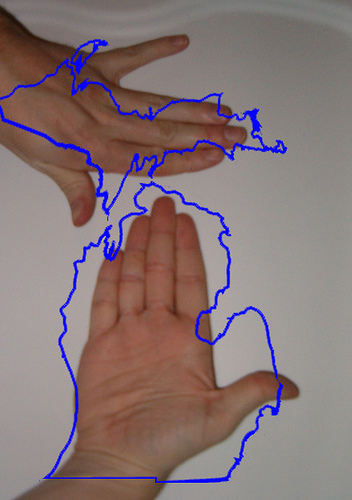
I was once asked by a friend at grad school way down in Ohio just where “up north” is in Michigan. That’s a tough one to answer—even with my trusty map:

http://greatlakesecho.org/wp-content/uploads/2010/07/michimap.jpg


Most people would probably assume “up north” refers to the cardinal direction North, literally getting in a car and driving northward. Now, don’t get me wrong. On Memorial Day weekend, people in Michigan DEFINITELY pack their cars, load the campers, stock the boats and hit the road. If you’ve ever accidentally ended up on I75 headed north on a holiday weekend—okay, any weekend in the summer—you might think the entire population of the state is migrating northward. Every campground from West Branch northward seems to fill to capacity by Friday night, and the familiar acrid smell of campfires wafts as far away as Ohio, I’m sure. If you’re not headed north, you’re probably laughing at those who are, sitting on lawn chairs in your driveway watching the endless line of traffic, taking part in this ritual of “heading north” even without leaving your own house.

I’m of the mindset, though, that “up north” is about something much more than a direction. For me, going up north is all about escapism—a chance to get away from the daily grind and reconnect with family, friends, nature…. Remember that old 80s’ haircut the mullet? The saying that went along with the look was something like “Business in the front; party in the back.” “Up north” for me is a lot like that haircut: Work hard down here during the week; head north to play harder during the weekend.

Who wouldn’t like to escape every now and then? Who wouldn’t want a little “up north” every now and then?

What’s your favorite “up north” memory—whether you’re from Michigan or not?

Thursday, May 30, 2013

Postpartum: How to Go On After Completing a Novel


So it’s been a while since I’ve posted anything here—but I’ve got good reason. I’ve been in the trenches finishing the first draft of Novel #2. I’m happy to announce the official birth of a 93,333 word manuscript on May 22. It may be sacrilegious to write this, but writing a novel really is quite a bit like the birth of a child for me (and I can say that since I’ve done both twice now).

Now, before you think I’m crazy, let me share the similarities. This second book has taken me somewhere near the nine-month timeframe to draft. During that time, I’ve faced plenty of discomfort, nervousness, paranoia, and complete lack of control—all words that I would have used to describe both my pregnancies. And just when I started to wrap my brain around this new little being inside of me, it was time for said being to pop into the world.

As excited as I’ve been to finish my second book, I’ve been going through an odd sort of separation anxiety this past week. First, it was my playlist that I had to say goodbye to. I’ve had the same Pandora channel playing while I wrote for nearly the duration of that recent project, but when I turned it on this week, it didn’t feel right anymore. The music seemed jarring, and I found myself distracted by it rather than inspired.

The loss of the music wasn’t as monumental as the loss of my characters. Over this past week, I’ve had to come to the realization that I won’t be spending the same amount of time with them ever again. It’s bizarre to admit it, but those characters are like good friends by now. I’ve spent nine months in their heads (or is it that they’ve spent nine months in mine?), and even though I have a great deal of editing left to go, our relationship is on the downslope. I know fully that soon I’ll be engrossed in a new project—and these characters will go back to just being what they are—figments of my imagination.

We recently celebrated the birthdays of my two kids, complete with cake, balloons, presents, and all the fanfare such events require. Yet, there is a piece of me that mourns another year of childhood behind them.  Just as I have to trust my children to go out into the world—to be who they are—I have faith that this new novel will do the same. Make Mama proud, Baby!

Okay, now tell me, do you experience separation anxiety after you’ve completed a major project? How do you let go?

Monday, April 8, 2013

NaNoWriMo: Off to Camp


It’s spring, and while the weather isn’t very wonderful (I can still see snow from where I sit), I have a bad case of spring fever. I’m not much of a fan of yard work, but about now I’d happily grab a rake and do some damage to our lawn. Every time I see a flower commercial on television, I get a bit giddy at the thought of planting something, even knowing full well that Lake Michigan guarantees us many more below-freezing nights before it’s safe to plant.

As if the general lure of spring isn’t enough of a distraction, we’re in the process of readying our house to sell. Between the constant cleaning, hunting for realtors, and considering all the what-ifs, a million little bees are buzzing around in my head constantly.

With all that in mind, I decided I needed a little motivation to finish my current work-in-progress. I’ve been working away at this book for six or seven months and am very excited to see where it goes—but I’ve just been so distracted from working. So, I’ve signed up for Camp NaNoWriMo, a thirty-day writing extravaganza.

For those who aren’t familiar, NaNoWriMo refers to the National Novel Writing Month: November. NaNoWriMo is actually the brainchild of an organization called The Office of Lights and Letters. The goal is quite simple: Write a novel during the month of November—or at least 50,000 words of it. They provide the goal and a place to commiserate with and/or gloat to fellow writers online; the writers provide the words—screenfulls of them.

I’ve been intrigued by the idea of such an endeavor, but I’ve flaked the past two years. The word count just seemed too daunting. How could I possibly write 50,000 words in a month with work, a family, and a million other excuses?

Now, if you’re keeping track, it’s not November—not even close. The fact is, NaNoWriMo has grown quite a following over the years. There are so many crazy writers out there who are gluttons for punishment that the people over at The Office of Lights and Letters expanded the idea to include two camps each year, one in April and one later in the summer. The best part of Camp NaNoWriMo (besides skipping the mosquitoes and wet weather usually associated with the word “camp”) is that the word count is flexible. Those of us with lots of excuses now have one fewer reason to skip out of the fun.

And so, here I sit, contemplating how many more words I need to write before the end of the month. Yes, I know my goal should be to concentrate on just writing my best to finish my current novel, but I feel oddly pressured by that magic number, even though I took it easy on myself with just a 20,000 word goal. I’m proud to say I’ve written over 7,000 words already this month, so I’m on track to succeed, but I’m really hoping when I reread what I’ve written at the end of the month, I won’t find that it’s quantity rather than quality.

Oh well… I needed motivation and now I’ve got it. Fewer than 13,000 words left to go… or the end of my book, whichever comes first!

Wednesday, February 20, 2013

Hearing a Novel: Creating a Novel Playlist


The book Sing You Home by Jodi Picoult has a line that simply reads, “Every life has a soundtrack.” In recent days, I’ve become a convert to the idea that every book has one, too.

I understand that this is by no means a new or original idea. I remember giving it some thought a while back when I wandered through Stephanie Meyer’s website. She actually posted a playlist for each novel, sort of a snapshot of the music she listened to while writing. At the time, I remember thinking that it was quite odd for her to post such a thing. Who would want to know what she listened to while she wrote? What difference did the music make since it wasn’t as if it was a movie (yes, I realize it would eventually become a movie, but this was way before that point). A novel is a visual experience rather than an auditory one, isn’t it?

I suppose I’ve betrayed myself as a reader in that last line. I am a visual person, so when I read, I don’t generally “hear” the book. I guess I’m a visual writer as well, focused on the words rather than the music that informs them. Maybe that’s why this soundtrack idea was really challenging for me to wrap my brain around. However, this playlist thing seems to be taking over the literary world. Erin Morgenstern and Jennifer Egan, both best-selling authors whose work I've enjoyed, even have playlists on Spotify to give context to their books.

In wandering some of my favorite writing blogs, I found out that the idea of a playlist, or soundtrack, for a novel has become fairly commonplace, but I was still a bit curious about why someone would go through the trouble to do this. After all, isn’t writing a novel about WORDS rather than music?!

After a good deal of research, I think I’m starting to get it. Young Adult writer Christina Farley says she creates a playlist to establish the mood of a piece and to maintain a consistent tone. I wasn’t conscious of this, but I have sort of accidentally done this in my first two novels. I am a devout Pandora listener, and I was rather perplexed when what I normally listened to—the songs that were the backdrop for Novel #1—were far from what I wanted to listen to as I wrote Novel #2. I’m not much of a country music fan, but somehow, I’m drawn to certain country artists as I write this time. I couldn’t have explained why if someone asked me… but I’m starting to understand now!

So, okay, maybe I have some background music in my head for my books, but a playlist? Really? Do I need to go that far? Rob Reid writes in Wired Magazine that he found each of his characters had a different playlist, which helped to define them—and some of this characters even have very different musical tastes than he does. Ink Out Loud has this incredible discussion of how to think about the playlist for a novel, including themes for specific scenes, characters, and even the places depicted in the book. When I really got thinking about it, one of my favorite novels from 2012, written by a former Miami University colleague of mine Jason Skipper, Hustle, was saturated with music references. I’m not sure if Jason has posted a playlist for the book somewhere, but I’m sure he easily could. I’ve even heard he’s been persuaded to sing during his readings to bring that playlist into the foreground.

Whoa...  my mind is reeling. Each character could have a song? Or maybe each scene? My book could be like a movie? This sounds a bit overwhelming—yet I’m really intrigued.

Suddenly I’m looking back at my first novel and hearing a solo piano playing behind Preston’s words, something feisty—and a bit sultry—blaring out of Tess’s radio as she drives to her photo shoot, and the strains of something a bit melancholy tinged with a bit of anger as Grace reads the letter from Jon’s lawyer. Suddenly, I’m HEARING my novel… and it sounds amazing!

The best resources I've found so far for creating a playlist for a novel include Pandora, Playlist, and Spotify. Do you include a playlist on your website or blog for your books? What has worked best for creating and sharing that playlist?

Monday, February 4, 2013

It’s Research, Mom, Really! Tips for Writing Sex Scenes


I’ve set before myself an interesting task for this week—an interesting and awkward and blush-inducing task. It’s actually something that I’m sure most writers have to consider at some point in their careers—of course there are some obvious exceptions, but I’ll let you explore those on your own.

This week I’m researching how to write sex scenes.

Yes, you read that correctly. I muddled through a few sex scenes in my first novel, but the writing was achingly slow because I agonized over every word. No, I didn’t break out the thesaurus to find that perfect word for each body part, but it felt impossibly difficult to figure out how to describe what characters are feeling and doing in that very intimate moment. That’s the moment when I just want to say “…And the door closed” or “…And they woke up beside each other the next day.” As a reader, though, I know what a cop-out that is (I’d still like to slap Stephanie Meyer!), so I’m doing my homework. Dear readers: I solemnly swear that I won’t skip the good stuff.

To aid me in my quest to become better at writing sex scenes, I turned to the experts: the writers of Harlequin Romance novels! I went to my local used book store and picked up a selection of novels to get a feel for (oh gag) (double gag) (ugh!) the fine art of writing about sex. So far, I haven’t been disappointed. Truthfully, though, I’m not sure that I could reproduce much of what they include in their scenes without laughing hysterically. (Just ask my husband who had to listen to me read the over-the-top descriptions aloud because I couldn’t keep the hilarity to myself.)

Okay, so if Harlequin won’t give me all the answers, where do I go? I decided to peruse the internet. These writers are the founts of knowledge, right? Honestly, there were really only about two things all these sources agreed upon in their discussions (although I certainly hope I already knew these beforehand):

1.      Use all five senses if possible. Sex includes more than just what we see or feel they tell me.

2.      Don’t use words like “penis” and “vagina.”  (Sorry, I guess now I’m making you blush, too!) As one writer said so well, writing a sex scene shouldn’t be like a trip to the gynecologist!

So, while I’m not sure I’ve accomplished all I set out to discover about this topic, I did pick up some useful tidbits in my research:

1.      Sex isn’t about the sex; it’s about advancing the story & understanding the characters.

2.      Sex is as much about what comes before and after as during.

3.      The best sex scenes don’t include clichés or euphemisms.

4.      Reading the sex scene aloud should result in heat—not laughter.

5.      #4 above notwithstanding, sex is humorous. If everything goes perfectly in a sex scene, it’s probably not very realistic!

Now, armed with my new-found knowledge, it’s time to get back to Book 2. I’ve got some hot sex to write—sorry, Mom!

Tuesday, January 29, 2013

"...Make them Wait": Writing in Serial Form

This week I’ve started posting chapters of my first novel on this blog [no longer available here]. The idea was simply that the blog was an easy way to share this work with others without making a bunch of hard copies. I’ve decided that I’ll do another revising pass on each chapter before I post it, knowing full well that the work is far from finished and needs all the help I can give it before I show it to anyone. That having been said, I’m also working on Novel #2, which I’m really enjoying writing, so I’m a bit slow on revising and then posting new chapters of Novel #1.

That reality became very clear when I received a message from my dear friend Heather saying simply “Chapter 2… Please!”

Somehow that note got me thinking about my process, which oddly led me to think about my favorite author, Charles Dickens, and how he published almost all of his works serially. For those non-Dickens fans out there, most of his works were published in 20 monthly installments of around 32 pages each. This was a fairly common practice in the day, so much so that publishers would often tout the phrase “Make them laugh, make them cry, make them wait!” The benefit to the publication (and the authors themselves) was that it was much more affordable for people to buy the novel on the installment plan rather than pay a larger sum of money up front for a complete novel. Simple economics, right?

Not quite. While I’m sure Dickens was appreciative of the way serial publishing gave him more readers. I tend to think there’s more to the story of why he continued to publish that way. See, an interesting fact about Dickens that sets him apart from many of his contemporaries was that he not only published serially, but he wrote serially as well.

Think about that for a moment. The way I see it, Dickens would write the first 32 pages—maybe even the first 64 pages—and then he’d wait for the reaction of the audience before writing the next installment. If, for example, the audience hated the main character, Dickens could change things up so that an originally more secondary character would take the lead in the next installment. If a character died and the audience took it poorly, SURPRISE! The character wasn’t really dead at all—it just seemed that way! The audience was intimately factored into every one of Dickens’ novels.

I cannot imagine writing that way, being continually beholden to the variability of readers’ opinions. I’d be afraid the final product wouldn’t be mine at all but would be a complicated collaboration with my ideas bending and bowing to others’ input. In practical terms, whose name would go on the cover?

It’s an interesting idea, though, isn’t it? In some ways, I think everything I write is a complicated compilation of everyone I know and everything I’ve heard and experienced. Although I’m not as brave as Dickens, I appreciate the overt way he used the audience to shape his books.

One of my favorite pieces of Dickens’ work is a seldom-read unfinished novel called The Mystery of Edwin Drood. Remember that installment plan? The problem with that modus operandi was that Dickens died with only 6 of 12 planned installments of his final novel complete. To this day, although many have ventured guesses, no one really knows who killed Edwin Drood. Given what I know of Dickens, though, maybe he didn’t even yet know himself.

Sunday, January 27, 2013

To Avoid Avoiding : Robert Benchley & Procrastination


The secret of my incredible energy and efficiency in getting work done is a simple one. I have based it very deliberately on a well-known psychological principle and have refined it so that it is now almost too refined. I shall have to begin coarsening it up again pretty soon.

The psychological principle is this: anyone can do any amount of work, provided it isn't the work he is supposed to be doing at that moment.


("How to Get Things Done," in Chips off the Old Benchley,1949)


I came across the gem above from actor, critic, and comedic writer Robert Benchley today as I thought about why it is that I procrastinate so much when it comes to writing my novel. This has been a continual problem for me, and it’s one that I have never been able to understand.


The real quandary is that I like to write—I may even love to write. I’m not like many of my writing students who whine that they hate writing and therefore can’t determine where to begin. They spend countless hours avoiding the task out of a mix of fear and disdain. On the contrary, for me, there’s nothing like sitting down at my computer and letting a fictional character take me somewhere I didn’t expect to go. Once I start writing, every bit of concern and anxiety I may have had about the bills that need paying or the meeting I need to prepare for disappears as my only focus is recording what is in that character’s mind.


So why do I do everything I can to avoid sitting down at the computer and letting the magic happen?


I don’t have that problem when it comes to my other great love, reading. I’ll curl up with a good book at any opportunity—in a doctor’s office, in the car waiting for a meeting to begin, in the bathtub, anywhere—even if it’s only for a few short minutes. Like writing, reading takes me away from the world I live in with floors to be vacuumed, diapers to be changed, and email messages to respond to. I relish that escape.


Reading Benchley’s thoughts today got me thinking again about my procrastination habit. I have focused my energies thus far in pondering the “why” of my habit. I feed the procrastination monster a bit more as I wonder why it is I just don’t sit down and write. Benchley would probably tell me it’s time to strategize my way around the impasse. I can think of only one surefire way to avoid avoiding writing.

I’m going to go grade student essays.

Saturday, January 26, 2013

I'm Snow Not Bragging...


As you can see from the NASA satellite photo above (taken 1/22/13), it's snowing in Michigan. While that may not seem all that surprising to most people, it’s been quite shocking to those of us living here. See, last year we got very little snow, barely enough for my husband to bother dragging the snow blower out of the garage. Up until this past week, snowfall amounts for this season have been paltry.

To put it frankly, our snow totals have been nothing to brag about. Therein lies the problem. See, here in the great state of Michigan—especially the West side of the state that leans out into Lake Michigan—we enjoy complaining about the white stuff that covers our landscape a large portion of every year. During every snow storm, we call our friends and family to keep them up to date with the ever-increasing totals, haranguing Mother Nature and wondering aloud why we don’t all move to Florida. When the weatherman forecasts a winter storm--especially if the words "lake effect snow" are included--we grin and get ready for an opportunity to tell all of our far-reaching network how miserable we are. When the plows don’t get the roads cleared fast enough, we shake our heads in disgust and then tell everyone we know how smart we were to buy that four-wheel drive vehicle. Snow days for the kids just give us one more way to illustrate to those less snow-fortunate how rough Michigan winters really are.

Let’s face it: We love to complain about the snow, but we love even more to have enough of it to brag about to everyone we know.

Oh, by the way, in case you didn’t hear, according to NOAA, Muskegon had around a foot of snow by Thursday, 1/24, and that’s not counting the additional 6-8 inches that fell across the area on Friday. Not that I’m bragging…